
Email Signup
Operations
Exploration
The La Negra mine was initially in production from 1971 to 2000 operated by Industriales Peñoles S.A. de C.V. The mine was put on care and maintenance in 2000 and was acquired by Aurcana in 2006, Aurcana restarted the operation in 2007. Production is achieved by means of mine portals situated at the base of a mountain, and the mineral resources at the mine have been advanced by means of drilling from underground.
Mine development and exploration has pursued mineralization laterally and vertically while assessment of the potential of the upper portion of the mountain had been deferred until recent surface mapping identified some gold and silver mineralization in skarn at surface.
The potential for finding and developing new zones of mineralization at La Negra is good. Historically, exploration at La Negra by both Peñoles and Aurcana has been able to both replace and increase the mineral resources. Exploration and development of deposits of this type require extensive direct exploration by means of core drilling, cross cutting, drifting and development workings.
The Company has its own diamond drill rigs on site, and utilizes an on-site laboratory to ensure rapid turn-around of assay results.
Geology
Silver and base metal mineralization at La Negra is closely associated to skarn deposits in a number of blanket or “manto”, chimney-like veins, and breccia deposits. Mineralization at La Negra may be massive to disseminated in nature. Sulphide minerals of economic interest include galena, sphalerite, chalcopyrite, and hessite (silver-tellurium sulphosalt mineral). Accessory minerals include andradite – grossularite garnet, hedenbergite, calcite, spurrite and quartz with varying amounts of pyrite and pyrrothite. There is a close association between galena and hessite.
La Negra is located near the southwestern edge of the Sierra Madre Oriental Mesozoic fold-belt of Central Mexico. Tertiary volcanic rocks dominate to the west and Mesozoic limestone, shale and sandstone to the east. La Negra is hosted within the Cretaceous El Doctor Formation, a carbonate unit that overlies Jurassic Las Trancas Formation shale and greywacke. These rocks are strongly folded and faulted. Eocene -aged calc-alkaline granodiorite - diorite rocks intrude the El Doctor and are central to a well-developed polymetallic skarn mineral system.
Mineralization occurs within medium to thick-bedded limestone of the El Doctor Formation, localized preferentially near the external edge of a zone of alteration centred upon northeast and a northwest-trending intrusive dykes and stocks of diorite composition. Two principal north-east and north-west trends of intrusive rocks and mineralization are defined, known as La Negra, Monica, Alacran and San Pedro-Dificultad-Virginia Blanca Valenciana. Within these two trends more than 20 different deposits have been discovered, though some of them join together at depth.
Manto and chimney-style deposits are the priority targets at La Negra. These can range from 40 to 300 metres in length and from 0.50 to 40 metres thick. Vein-style deposits vary from 80 to 120 metres in length and 10 to 60 metres in depth at 0.5 to 1.2 metres in width.
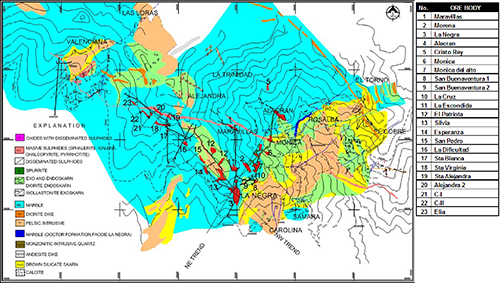
Geologia Superficial Dec 2014